A practical guide for families
What to Check Before Choosing an Organic Crib Mattress
A crib mattress is an unshowy object with an unusually important job. It must fit the crib precisely, provide a firm, flat sleep surface, and stand up to the ordinary work of family life. Organic materials may matter to your household, but a label alone cannot answer the questions that matter most. A careful comparison starts with size and safety, then moves through construction, certifications, surface materials, and the less glamorous details of cleaning and care.
Start with the crib, not the label
It is easy to begin a mattress search with a list of materials or a promise printed on a product page. For a crib mattress, however, the first practical question is whether the mattress is designed for the exact crib in which it will be used. A mattress that is too small can leave a dangerous gap; one that is too large may bow, buckle, or fail to sit flat. Neither a pleasing fabric nor an impressive certification can compensate for a poor fit.
Check the crib manufacturer’s instructions for the required mattress dimensions and any limits on mattress thickness. Then compare those specifications with the mattress’s actual dimensions, not merely a broad label such as “standard crib size.” Small differences can matter. A mattress may be advertised as standard-size while varying slightly in length, width, or depth, and cribs themselves are not all identical.
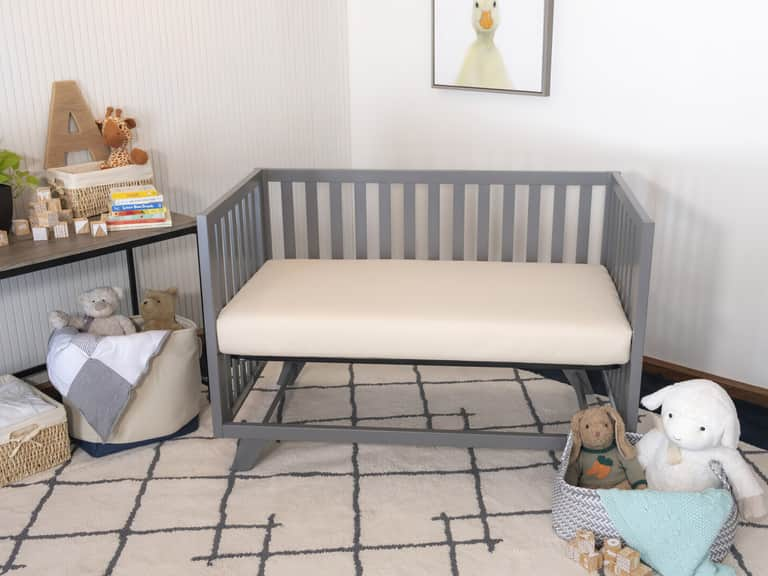
After placing the mattress in the crib, inspect the fit around the perimeter. The mattress should lie flat and be snug against the crib sides. Check every edge and corner, and make sure the mattress does not shift easily or leave an opening when gently pressed toward one side. Follow the crib and mattress manufacturers’ instructions for the appropriate fit test; do not rely on a rough estimate or on a product description alone.
Fit should be rechecked if the mattress is replaced, the crib is converted or adjusted, or a different sleep space is used. A mattress that fitted one crib well is not automatically suitable for another. Keep the packaging or product documentation until you have confirmed the dimensions and fit in the actual crib.
Firmness and a flat sleep surface
For an infant, the central issue is not whether a mattress feels luxurious to an adult hand. It is whether the mattress is firm, flat, and intended for infant sleep. A soft or deeply yielding surface can conform around a baby’s face or body. A firm surface is designed to resist that kind of indentation and to provide a stable base. This is why a crib mattress should not be judged by the comfort expectations people bring to their own beds.
Press the surface according to the manufacturer’s guidance and look for clear specifications about firmness and intended use. Product language such as “supportive,” “plush,” or “comfortable” is not a substitute for information about infant suitability. Nor should an adult’s quick showroom impression be treated as a complete safety assessment. Refer to current guidance from relevant public-health authorities and follow the instructions supplied with both the crib and mattress.
Some mattresses are described as two-stage, with one side intended for an infant and another for a toddler. This design can be useful as a product feature, but the two sides are not interchangeable during infancy. Confirm which surface is designated for the infant, how the manufacturer distinguishes the sides, and when the mattress may be flipped. Use only the surface appropriate to the child’s age and the product instructions. A toddler side should not be used early simply because it feels softer or seems more inviting.
A flat surface matters too. Avoid improvised additions such as extra padding, positioners, wedges, or toppers unless a qualified clinician has specifically advised otherwise. Use the mattress as designed, with only a fitted sheet that is intended to fit it securely. A protective cover or pad, if used, should be compatible with the mattress, fit tightly, and be permitted by the crib and mattress instructions. Bedding should not bunch, loosen, or create a soft layer over the sleep surface.
Read the materials description closely
“Organic” can describe a material, a component, or a certified production process; it does not necessarily describe every part of a finished mattress. A cover might be made from certified organic cotton while the core, waterproof layer, fire barrier, thread, zipper, or adhesive has a different composition. The useful question is not simply whether a mattress is organic, but what the claim applies to.
Look for an itemized materials description. It should identify the cover fabric, the inner support structure, any comfort or cushioning layers, waterproofing, fire-barrier components, and other substantial materials. If the description uses broad phrases such as “natural,” “clean,” or “chemical-free” without naming the materials, seek clarification. Those terms are not a complete inventory and do not, by themselves, establish how a product performs or how it was made.
Organic cotton is common in mattresses marketed to families seeking certified organic textiles. Other products may use materials such as wool, latex, or an innerspring system, while some use a non-foam support structure or a waterproof surface. Each construction has its own care considerations. A mattress with a removable textile pad, for example, will need instructions explaining whether the pad is washable and how it should be reattached. A waterproof surface may be wiped clean, but the underlying mattress may still have limits on exposure to moisture.
Consider what the materials mean in daily use. Cotton may feel familiar and breathable, but the finished surface and its performance depend on the complete construction. A waterproof barrier may make cleanup easier, but it is important to understand what it is made of and how to care for it. A removable cover can simplify some kinds of cleaning, yet it should not be assumed that every layer can be washed or that removing the cover is permitted.
Families with known sensitivities can use the materials list to focus questions, but no single material claim guarantees that a child will have no reaction. If a baby has a diagnosed allergy or a particular medical need, discuss suitable bedding with the child’s clinician. Keep the manufacturer’s full composition and care information available rather than relying on a short retail summary.
Understand what a certification does—and does not—say
Certifications can make a comparison more concrete, provided you know what has been certified. A certification may apply to the fiber, the textile processing, a component, a facility, or the finished product. Those are different claims. The presence of a certification logo on a web page does not automatically mean every layer of the mattress is covered by that standard.
Look for the name of the certifying organization, the scope of the claim, and, where available, a certificate number or a way to verify the certification. Check whether the certificate concerns the organic content of a fabric, processing requirements, emissions, chemical testing, or some other specific feature. A standard that evaluates one of these areas should not be treated as proof of every other quality a family may care about.
When a product page says that a mattress is “certified organic,” ask which components are included. If it says the cover is organic, that is narrower—and more precise—than a claim that the entire mattress is certified. Precise descriptions are useful; vague descriptions deserve a closer look. If the manufacturer provides a materials document or certification record, compare it with the wording on the retail page.
Certification is one piece of a decision, not a shortcut around basic checks. It does not tell you whether the mattress fits your crib, whether its infant surface is firm and flat, whether it is suitable for your specific model of crib, or whether its maintenance requirements are realistic for your household. A well-documented claim is valuable, but it belongs beside, not above, those practical questions.
Compare construction without getting lost in the vocabulary
Crib mattresses can look similar from the outside and differ considerably within. The core may use coils, a structured support material, or another design. The number of layers, their thickness, and the way they are joined influence the finished mattress. Families need not become mattress engineers, but should be able to find a straightforward account of how the product is built.
For an innerspring model, ask what kind of spring system is used and how the structure is covered. A coil count, on its own, is not a reliable measure of safety, firmness, or quality. The shape, gauge, arrangement, and surrounding materials all contribute to performance. A manufacturer should describe the intended infant surface and provide relevant dimensions and care instructions, rather than asking a spring count to do all the explaining.
For a mattress with a removable or washable top layer, establish whether that layer is part of the approved sleep surface and how it must be attached. A breathable or quilted component may sound appealing, but words such as “breathable” are not a substitute for safe use instructions. Check how the product is meant to be assembled, whether the pad can be used with a fitted sheet, and what the manufacturer says about replacement or washing.
Look as well at the edges, seams, and overall finish. A durable cover and sound stitching can matter when a mattress is used over time, but construction quality should not be inferred from a photograph. Ask how the cover is cleaned and whether repairs are allowed. If a component is damaged, determine whether the manufacturer provides a replacement or expects the entire mattress to be retired.
Make care instructions part of the comparison
A mattress’s care requirements are easy to postpone until after purchase, when an accident has already occurred. Read them beforehand. The instructions should explain what to do with spills, how to clean the surface, whether any cover or pad is removable, and how long the mattress must dry before it is used again. If the instructions are difficult to find or ambiguous, ask the manufacturer for a written answer.
Moisture deserves particular attention. Liquid that reaches internal layers may be difficult to remove fully and can create conditions in which odor or microbial growth becomes a concern. Do not assume that a washable cover makes the core washable, or that a waterproof surface permits soaking. Follow the product’s specific directions and allow any cleaned component to dry as directed before returning it to use.
Check whether the mattress can be cleaned with ordinary household products or whether certain cleaners, bleach, heat, or solvents are prohibited. Some materials can be damaged by high temperatures or harsh chemicals. If the mattress includes a removable textile layer, note the washing temperature, drying method, and any limits on repeated washing. A component that requires special handling may still suit a household, but it should not come as a surprise.
Think through the whole routine: who will clean the mattress, how frequently, and where a wet component can dry? Is the cover removable without tools? Can the mattress be handled safely by one adult? Is the surface easy to wipe? These are not decorative details. They determine whether the care plan can be followed in the middle of ordinary family life.
A fitted protector may be useful for some households, but it must not interfere with the mattress’s fit or create a loose layer. Confirm compatibility with the mattress and crib manufacturers. Choose an appropriately sized, tightly fitted product and follow its own care directions. A protector should not be used to disguise a mattress that no longer fits, has become damaged, or cannot be cleaned as intended.
Consider lifespan, rotation, and changing needs
Some crib mattresses are designed with an infant side and a toddler side; others have one intended surface. Read the product guide to learn whether rotation or flipping is permitted. A two-sided mattress should be flipped only at the stage and in the manner specified by its manufacturer. A one-sided mattress should not be turned over simply to even out wear if the underside is not designed for sleeping.
Inspect the mattress regularly for sagging, broken components, torn seams, exposed filling, or a cover that no longer stays secure. A surface that has become uneven or damaged may no longer perform as intended. Follow the manufacturer’s replacement guidance and any applicable safety recommendations. Do not assume that an older mattress remains suitable simply because it once fit the crib.
When considering a used mattress, be especially careful. Confirm its age, history, condition, cleaning record, and compatibility with the crib. Check that it has not been exposed to significant moisture, stored in unsuitable conditions, or altered with non-original padding or covers. If its history is unknown or the construction is damaged, a new mattress with clear documentation may be the more straightforward choice.
Keep the receipt, model number, care guide, and certification information. These details are useful if you need to confirm a warranty, obtain a replacement part, or check whether the manufacturer has issued a safety notice. A product’s warranty is not a substitute for safe construction or correct fit, but it can clarify what the company promises about defects and what conditions void coverage.
A simple comparison checklist
When several organic crib mattresses seem plausible, place them side by side using the same questions. This keeps attention on the features that affect safety and everyday use, rather than on the most persuasive packaging.
- Dimensions: Does the mattress match the crib manufacturer’s specified size and thickness?
- Fit: Does it lie flat and fit snugly in the actual crib, including at the corners and edges?
- Infant surface: Is the intended infant side clearly identified as firm and flat?
- Materials: Does the manufacturer identify the cover, core, waterproofing, fire barrier, and other substantial components?
- Organic claim: Does the claim specify which material or components are certified?
- Certification: Is the certifier named, and can the scope or certificate be checked?
- Construction: Is the support system described clearly, without relying on a single number or broad marketing term?
- Cleaning: Are the instructions specific about spills, removable parts, washing, and drying?
- Compatibility: Are protectors, fitted sheets, and any included pads allowed and properly fitted?
- Documentation: Are the model number, warranty terms, instructions, and manufacturer contact details easy to find?
Not every household will give these questions equal weight. One family may prioritize a removable washable component; another may prefer a simpler, wipe-clean design. The essential checks remain the same: the mattress must fit the crib, provide the intended firm and flat infant surface, and be used and maintained according to reliable instructions.
Questions worth asking the manufacturer
When a product description leaves a gap, a direct question can be more useful than another round of browsing. Ask for the exact dimensions and whether they refer to the mattress itself or its packaging. Ask which layers are included in any organic or other certification claim. If the mattress has multiple sides, ask which side is intended for an infant and how the transition to the other side is determined.
For care, ask whether the core can ever be exposed to water, which cleaning agents are permitted, and how long a cleaned surface should dry. For construction, ask what the support material is and whether replacement parts or covers are available. Save the response with the product documentation. Clear, specific answers are a sign that the manufacturer has made the product’s limitations and intended use understandable.
If an answer leans on phrases such as “completely safe,” “chemical-free,” or “suitable for every baby” without providing relevant details, treat it as incomplete. No mattress can replace correct crib assembly, safe sleep practices, or professional advice for a child’s individual medical needs. A useful manufacturer explains the product rather than implying that one label settles every question.
The practical meaning of “organic”
For many families, choosing organic crib mattresses is a preference rooted in the origin or processing of materials. It can be a reasonable consideration, especially when the manufacturer documents the claim clearly. But organic status is not a synonym for safer fit, greater firmness, easier cleaning, or longer life. Those qualities must be evaluated separately.
The best comparison is therefore not organic versus non-organic in the abstract. It is a comparison among specific products, each assessed for fit, intended use, construction, material transparency, certification scope, and care. One mattress may offer a more detailed materials disclosure; another may have a cleaning method better suited to a busy household. The right choice is the one that meets the crib’s requirements and can be used as directed, while also fitting the family’s considered material preferences.
A careful shopper does not need to decode every technical detail alone. The manufacturer should be able to explain the mattress in plain language, and the crib instructions should make the required dimensions clear. Where a safety question remains unanswered, consult current guidance from a recognized public-health or consumer-safety authority rather than relying on promotional language.
A mattress chosen with care
The crib mattress is part of a larger sleep arrangement, but it is one of the few pieces of nursery equipment whose dimensions and surface characteristics need close attention from the start. Begin with the crib’s requirements. Confirm a snug fit. Check that the infant surface is firm and flat. Then read the material list, certification details, construction description, and cleaning instructions with the same patience you would give a warranty or a set of assembly directions.
Organic claims can help clarify what a mattress is made from, when they are specific and verifiable. They should never distract from the fundamentals. A good decision rests on clear information, a compatible crib, and instructions the household can realistically follow. In this particular corner of family life, the least dramatic choice is often the most useful: a mattress whose claims are precise, whose fit is right, and whose care routine makes sense at two in the morning.